Commercial demolition contractors in Paramus, NJ turn a vacant retail box, a fire-damaged office, or an aging warehouse into a cleared, build-ready lot. Permitting, asbestos abatement, and debris hauling usually drive the price and the schedule more than the actual teardown does. Here's what determines cost, how each phase really plays out, and what to check before you sign a contract.
What Is Commercial Demolition?
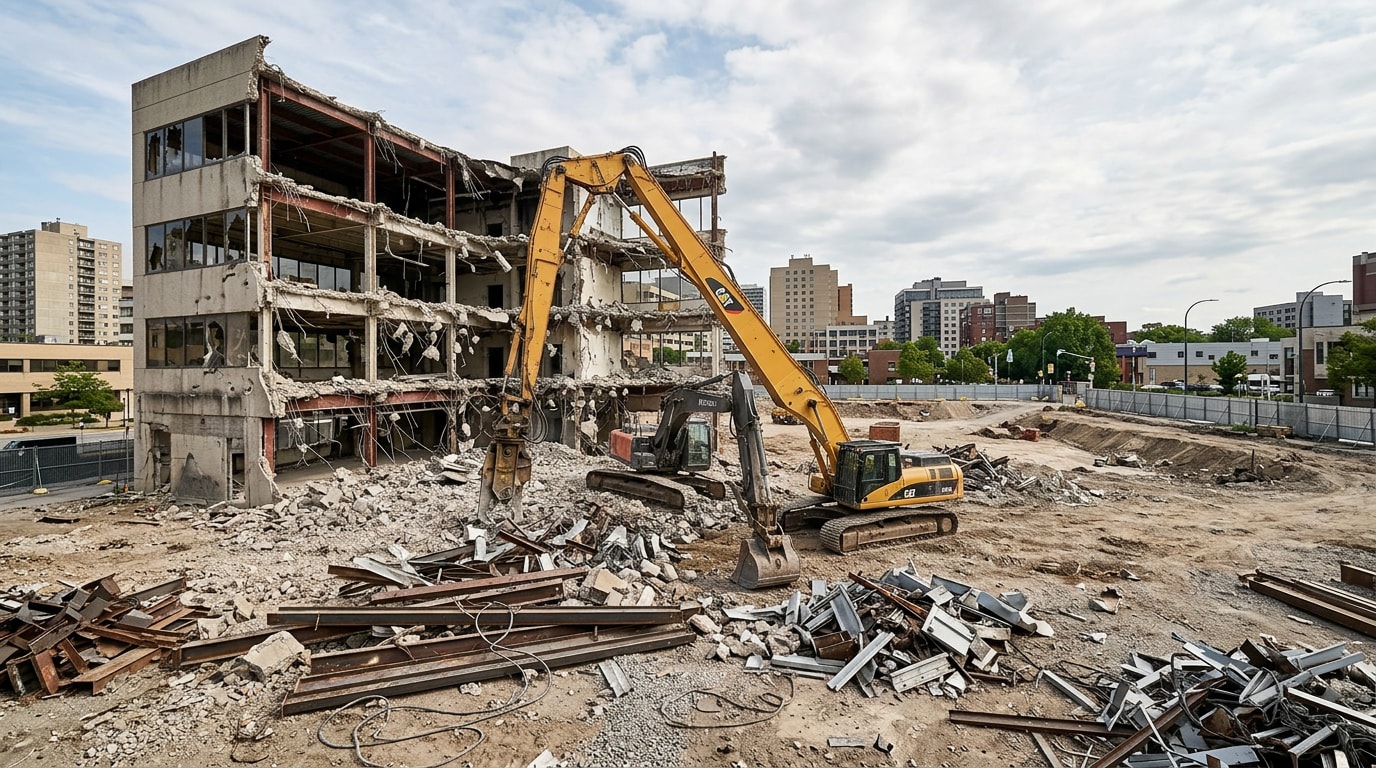
Commercial demolition is the controlled removal of an existing building, structure, interior components, or site improvements to prepare a property for renovation, redevelopment, or new construction. It differs from residential teardown work in scale, permitting complexity, and the range of regulated materials involved.
Contractors performing this work in New Jersey handle structures outside the single-family and two-family residential categories: retail centers, office buildings, warehouses, industrial plants, and institutional properties. Each one carries its own scope, equipment needs, and regulatory checkpoints.
In our work coordinating fit-outs and renovations across Bergen County, the demolition scope is almost never the part that sets the timeline. Abatement findings uncovered during the pre-demolition walkthrough are what usually move the schedule.
Commercial Demolition Services in Bergen County
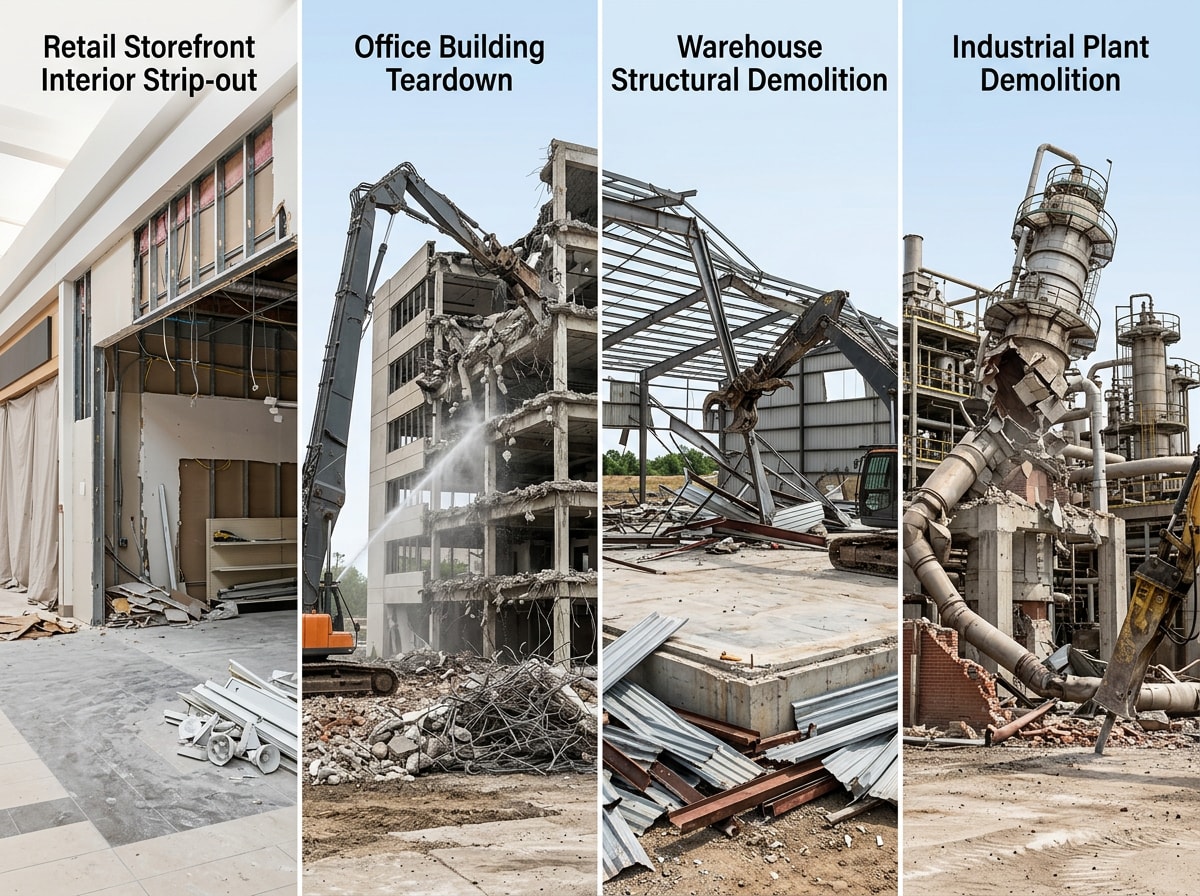
Commercial demolition spans an enormous range of project types, from interior strip-outs of a retail unit to full structural teardowns of an office complex along a commercial corridor. Scope, equipment, and crew size shift significantly depending on building type and site access.
The table below gives a general sense of how scope and duration tend to differ by property type. Actual numbers vary by site access, structure age, and abatement findings.
| Project Type | Typical Scope | Typical Duration |
|---|---|---|
| Retail storefront | Interior strip-out, some facade work | 1–3 weeks |
| Office building | Interior gut-out or full teardown | 2–8 weeks |
| Warehouse | Structural removal, concrete/slab demo | 3–10 weeks |
| Industrial plant | Equipment disconnection, structural teardown | 6–16+ weeks |
Explore recent project work or visit the homepage for the full range of services. If your scope also includes rebuilding after the teardown, our guide to commercial construction companies in Paramus, NJ covers what comes next.
What Drives Commercial Demolition Costs in Paramus
Cost estimates swing widely by structure type, hazardous material content, and site logistics. Commercial building demolition runs $8 per square foot on average in 2026, with a realistic range of $4–$15/SF depending on structure type, hazardous material content, and site logistics.
Asbestos is the single biggest cost swing factor on older Bergen County commercial buildings. The presence of asbestos or other hazardous substances requires specialized removal, adding approximately $2 to $3 per square foot to the overall cost.
Tight urban and strip-mall sites also push costs higher than open-lot demolition, since equipment access and dust/noise control both require more labor-intensive methods.
Structural Demolition
Structural demolition in dense northern New Jersey commercial corridors presents challenges that differ from open-site work. Shared walls, utility proximity, and limited staging space all factor into planning.
Full building teardown work is handled as a complete structural removal down to grade, followed by site prep for whatever comes next.
Industrial Demolition
Industrial demolition covers plant, warehouse, and manufacturing facility teardown. It differs meaningfully from office or retail work.
Heavier equipment, structural steel, and process-line disconnection are usually involved. Utility shutoffs require coordination with multiple trades before structural work can safely begin.
Selective Demolition
Selective demolition means removing specific structural or non-structural elements while leaving the rest of the building intact. It's the dividing line between a full teardown and a partial renovation, chosen when only part of a structure needs to come down.
This work typically combines mechanical selective demolition with manual, strategic dismantling for commercial, industrial, and institutional buildings. It's the right call for tenant fit-outs or partial renovations where preserving the shell or an adjacent occupied space matters.
Interior Demolition
Interior demolition, sometimes called a gut-out, strips a building down to its structural shell. Walls, flooring, ceiling tile, mechanical fixtures, and finishes come out while the exterior and structure stay standing.
It's the most common scope for office buildouts, retail turnovers, and restaurant renovations across Bergen County, where tenants change faster than the buildings themselves.
Emergency Demolition Response
Partial collapse, fire damage, or storm damage that leaves a commercial building unsafe needs a response now, not a scoping call next week. Crews stabilize the structure first, then remove hazardous debris before full assessment and permitting proceed.
Confirming a contractor's asbestos abatement licensing before an emergency happens, not during one, saves critical time, since fire and structural collapse usually create exposure that triggers abatement rules regardless of project size.
The Commercial Demolition Process: Permit to Clean Site
Every commercial demolition project in Paramus follows a similar sequence: permitting and planning, hazardous material abatement, physical teardown, then debris management and site clearance. Here's what each stage actually involves.
Do You Need a Permit for Commercial Demolition?
Nearly every commercial demolition project in New Jersey requires a municipal demolition permit, filed with the local Construction Official under the state's Uniform Construction Code. But not every demolition needs the same kind of permit.
A true demolition permit is required when the entire building is being demolished. Under the Rehabilitation Subcode, when a portion of a building is being demolished, this type of work is considered an alteration or reconstruction , which can sometimes be covered under a construction permit instead of a standalone demolition permit. That distinction matters for scheduling: a full teardown and a partial gut-out can move through entirely different municipal review tracks.
Before any demolition crew can start, federal standards also require a documented structural review. Prior to permitting employees to start demolition operations, an engineering survey shall be made, by a competent person, of the structure to determine the condition of the framing, floors, and walls, and possibility of unplanned collapse of any portion of the structure. For the full regulatory text, the New Jersey Division of Codes and Standards publishes guidance clarifying when a demolition permit versus an alteration permit applies.
Hazardous Material Abatement (Asbestos & Environmental Compliance)
Regulated materials, including asbestos-containing material and lead paint, must be removed by licensed abatement contractors before or alongside structural demolition. Any demolition or renovation operation at an institutional, commercial or industrial building is regulated by the Asbestos NESHAP.
Not every building triggers a full abatement requirement before demolition can start. If the total amount of asbestos to be removed or disturbed is less than 260 linear feet, 160 square feet, or 35 cubic feet off of facility components, then the Asbestos NESHAP does not require regulated asbestos-containing material to be removed before demolition or renovation activities occur. A pre-demolition asbestos survey is still the step that determines which rule applies, which is why abatement planning typically starts well before any equipment arrives on site. The EPA's Asbestos NESHAP overview outlines the full federal notification requirements that run alongside state rules.
Debris Management and Site Clearance
Most commercial demolition projects generate enough material that sorting on-site saves significant disposal cost. Capabilities at this stage typically include complete structure removal, concrete and masonry processing, site clearing, material recycling, and preparing the lot for the next phase of construction.
For projects anywhere in the township, see our Paramus, NJ service area page for coverage details, or request a free estimate to walk through permitting, abatement, and timeline specifics for your site.
FAQ
How Much Does Commercial Demolition Cost in New Jersey?
Commercial demolition generally runs from roughly $4 to $15 per square foot, with abatement-heavy or dense sites with limited access pushing costs toward the higher end. Final pricing depends on structure type, size, and how much hazardous material is present.
How Long Does Commercial Demolition Take?
Timelines vary widely once permitting and abatement are factored in. A small interior gut-out might finish in two to three weeks, while a full structural teardown with asbestos abatement can run two to four months from planning to a cleared site.
Do I Need a Full Demolition Permit, or Just a Construction Permit?
It depends on how much of the building comes down. A full demolition permit applies when the entire building is being removed; demolishing only part of a building is typically treated as an alteration and may be covered under a construction permit instead. Confirm which track applies with the local Construction Official before scheduling work.
What's the Difference Between Demolition and Selective Demolition?
Full demolition removes an entire structure down to grade. Selective demolition removes specific walls, systems, or sections while the rest of the building, including the structural shell, stays intact and in use.
What Happens to the Debris After Demolition?
Hazardous materials such as asbestos or lead-based paint follow specialized removal and disposal procedures required by state and federal rules. Non-hazardous debris is typically sorted on-site, with concrete, metal, and wood routed to recycling facilities wherever possible.
What License and Insurance Should a Commercial Demolition Contractor Carry?
A qualified contractor should carry active New Jersey contractor registration, general liability insurance, and workers' compensation coverage, along with asbestos abatement licensing where applicable. Demolition work itself should follow OSHA's demolition standard under 29 CFR 1926 Subpart T. Ready to scope your project? Request a free estimate and we'll walk through permitting, abatement, and timeline specifics for your site.